Manuscript edit
Line editing for read-aloud rhythm, age-appropriate vocabulary and sentence length, with the story kept in your voice. Picture books live or die on how they sound read out loud.
Editing, custom illustration, character design, printing and distribution for children’s books, run as one project by one team. You approve every illustration before it is painted, and the copyright in both the words and the artwork stays in your name.
A picture book is the hardest kind of book to self-publish alone, because the words, the art and the page turns all have to be designed together. Take the whole project, or only the parts your book still needs.
Line editing for read-aloud rhythm, age-appropriate vocabulary and sentence length, with the story kept in your voice. Picture books live or die on how they sound read out loud.
Original artwork for every spread, drawn for your story. You see rough sketches first, then line art, then final colour, and you approve each stage before the next begins.
A character sheet before a single page is painted: your hero from the front, the side and the back, with expressions, so they look like the same child or animal on every page.
Full-bleed spreads laid out with the text placed where the art leaves room for it, print-ready at your trim size with proper bleed and safe margins.
Board book, hardcover with a dust jacket, or paperback, on paper stock you choose. A physical proof copy is printed and posted to you before any full run.
ISBNs registered in your name, copyright filed to you, and listings across Amazon, Ingram, Apple Books and the wholesale catalogue schools and libraries order from.
A full-bleed picture book spread, typeset the way it would go to print: art running edge to edge, text placed where the illustration leaves room for it.
Wombat woke up early.
Today was going to be a VERY big day.
He had a plan.
A very, very big plan.
Swipe the spread sideways to see all of it.
Wombat’s Big Day! · 8.5" × 8.5" hardcover · full-bleed spread · Fredoka 22pt. This spread was produced by our team as a sample; the book and its characters are invented.
Style drives both the feel of the book and the cost of drawing it. We show you portfolios in the style you choose before anything is commissioned.
Soft edges and washes. The classic bedtime-story look, and the most forgiving for gentle, quiet stories.
Bold shapes and clean colour. Reads clearly at small sizes, which matters for board books and thumbnails.
Rich, textured and cinematic. Suits adventure and fantasy, and holds up on a large hardcover trim.
Inked linework with light colour. Busy, funny scenes with plenty of detail for a child to hunt through.
Torn paper, fabric and print textures. Distinctive on a shelf, and lovely for counting and nature books.
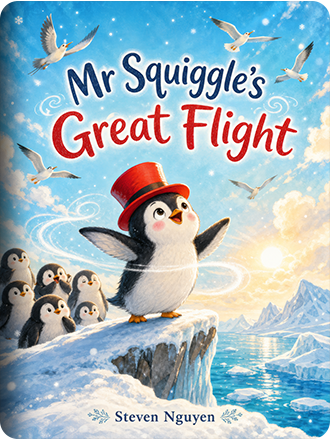
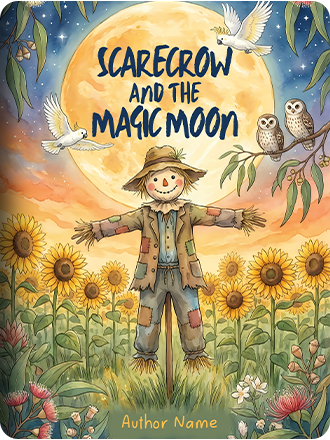
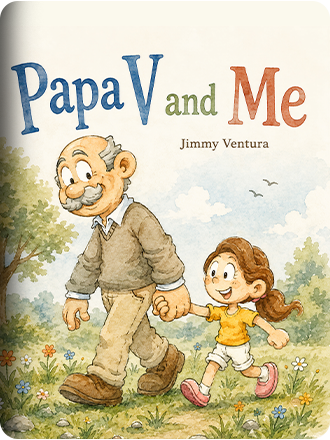
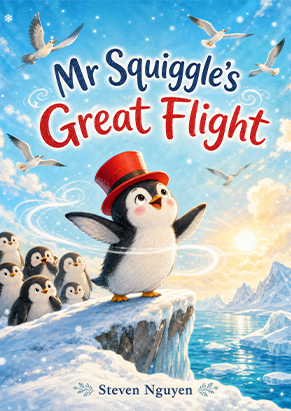
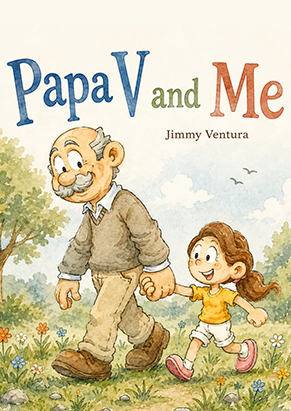
Covers from children’s book projects we have produced, across board books, picture books and early readers.
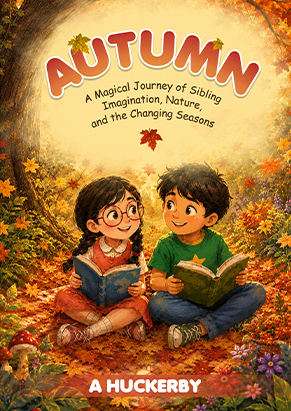
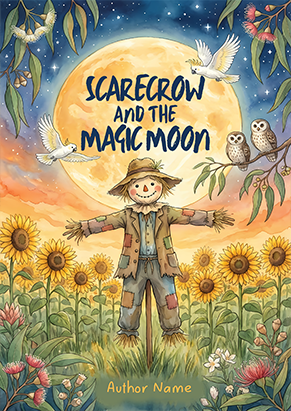
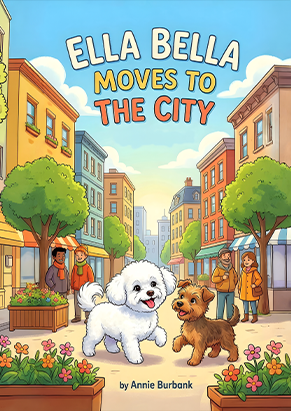
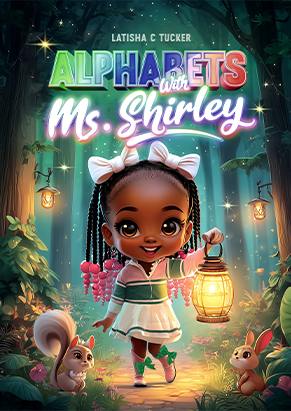
Age group decides word count, word count decides page count, and page count decides what the book costs to illustrate and print. Getting this right at the start saves the most money.
| Format | Age | Words | Trim size | Pages | What it means in practice |
|---|---|---|---|---|---|
| Board book | 0–3 years | Under 200 words | 6″ × 6″ or 7″ × 7″ | 12–16 thick pages | One simple idea per spread, rounded corners, almost no text. |
| Picture book | 3–7 years | 500–1,000 words | 8.5″ × 8.5″ or 8″ × 10″ | 24–32 pages | The standard format. Illustration on every spread, written to be read aloud. |
| Early reader | 5–8 years | 1,500–5,000 words | 6″ × 9″ | 32–64 pages | Short chapters, controlled vocabulary, a picture every page or two. |
| Chapter book | 7–10 years | 5,000–15,000 words | 5.5″ × 8.5″ | 64–120 pages | Spot illustrations at chapter heads, black and white to keep print costs sane. |
| Middle grade | 8–12 years | 20,000–50,000 words | 5.5″ × 8.5″ | 120–250 pages | Illustrated cover, text interior. Often the start of a series. |
These are the conventions retailers and librarians expect, not rules we invented. A book well outside them is harder to shelve, price and sell, and we will say so before you spend money on illustration.
Five stages, and you sign off at every one. Nothing moves to the next stage without your approval.
Share the manuscript, or just the idea. We read every word and come back with honest feedback, including whether the story is the right length for the age group you are aiming at.
Our editors work alongside you on language, pacing and age-appropriate tone, keeping your voice intact. For picture books we read the text aloud, because that is how it will be used.
Character sheets, then rough sketches for every spread, then final artwork. You approve each stage, and the interior and cover are laid out around the art.
You choose trim size, paper stock and binding. A proof copy is printed and posted to you, and nothing goes to a full run until you have held it.
We register the ISBN in your name, set up the retail and library listings, and hand over launch material so the book reaches young readers.
Illustration is the part of publishing where authors most often feel shut out of their own book. These are the terms that stop that happening.
No page is printed before you have seen it. Artwork comes to you as sketches first, when changes are cheap and easy, rather than as a finished surprise.
We pair the manuscript with an illustrator whose existing style fits your characters and tone, and we show you their work before anything is commissioned.
Illustration is the biggest cost in a children’s book and it scales with page count, so we quote after we know the spread count. The quote is itemised, fixed and in AUD.
Copyright in the text and the commissioned artwork is yours, the ISBN is registered to you, and every royalty dollar is paid to you. We take no share.
A named publishing specialist runs your project from the first read to the finished book, so you are never re-explaining your story to someone new.
Board books on thick stock with rounded corners, hardcovers that survive bedtime, and paper chosen for durability rather than the lowest unit cost.
Send the manuscript, a few pages, or just the idea. We will tell you which format it suits and what illustrating it would involve, before you spend anything.
What first-time authors ask us most, including the ones with answers you may not want to hear.
You can absolutely send us an idea. Some authors arrive with a completed manuscript, others with a handful of pages and a notebook full of thoughts. Both are normal starting points, and we will tell you honestly which stage yours is at.
No. There are a lot of moving parts in children’s book publishing, and you are not expected to know any of them. Your publishing specialist explains what happens at each stage before it happens, and nothing moves forward without your approval.
Yes, at every stage. You see character sheets, then rough sketches of every spread, then final colour art. Changes at the sketch stage cost nothing, which is exactly why we work in that order.
Illustration is the largest part of the cost and it scales with the number of spreads, so a 32-page picture book with full-bleed art on every page costs considerably more than a chapter book with spot illustrations. We quote in AUD after we know the page count and the style, and the quote is itemised so you can see what each part costs.
No. Pricing is walked through in detail before your project begins, so you know what is included. If you later add pages or change the format, we requote that change in writing before doing the work.
Illustration sets the timeline. A 24 to 32 page picture book typically runs four to six months from approved manuscript to printed copies, because artwork cannot be rushed without showing. Chapter books with fewer illustrations move faster.
You do. The artwork is commissioned for your book and the rights transfer to you, which means you can use it for merchandise, a sequel, a website or a school reading without asking anyone.
Yes. Plenty of authors do, and it lowers your cost. We will check that the files are print-ready at the right resolution, bleed and colour profile, and tell you before print if something needs fixing.
Almost always 24, 32 or 40 pages, because books are printed in signatures of eight. Writing to 32 pages from the start avoids padding the story or cutting it late, and we help you plan the page turns.
It is listed in the wholesale catalogue that schools, libraries and independent bookshops order from, which is the necessary first step. Whether an individual school or library buys a copy is their own decision, and nobody can guarantee it.
Yes, with one caution we give every author: rhyme has to scan perfectly or it trips an adult reading aloud, and it rarely survives translation. Our editors will tell you plainly if the metre is not working yet.
Yes. Illustrated ebooks are produced as fixed-layout files so the artwork and text stay where you put them, which is the format that works for picture books. We can set both up at the same time.
Send the manuscript, a few pages, or just the idea you have been telling at bedtime for years. We read every word, tell you what format it suits, and put an itemised quote in AUD in writing.